
Yerinde Dur
Ye-yerinde, yerinde dur (dur)
O seni bulur, ya
Biri olur, ellerin olur, ya (pu-pu)
Caddede tur, nasıl unutur? Ya
Konuş, otur, eller avutur, ya
~Demet Akalın and Sefo


$1500 per person
12
days
17/10/25-29/10/25
Stay
Tashkent
City Palace Hotel
-
Located in the heart of the city
Food, Coffee and Cocktails Much
Tashkent
Cafes, Restaurants and Bars
-
Arrows and Sparrows, located in Tashkent Park, fantastic view and coconut milk coffee
-
Besh Qozon, O’rta Osiyo Osh Markazi the most delicious plov in the most beautifully crafted restaurant, find a spot towards the back of the restaurant next to the fountain
-
The Bar Speak Easy, for great cocktails
Khiva
-
Terrassa Cafe and Restaurant for the best views and fantastic food
-
Dilnura, local recommendation, located outside the old city
Bukhara
-
Labi Hauz
-
Old Bukhara Restaurant
-
Donuts and Coffee, for brunch and baked treats
Samarqand
-
Platan Restaurant
Currency: Som [uzs]
Nightlife: Nukus 89, nightclub, local recommended in Tashkent


What’s the best time to travel?
Spring (April-June) and Autumn (Sept-Oct) are great for sightseeing and exploring the ancient sites. During October, carry some warm clothes especially if you’re making the hike to Khiva.
What’s the best network provider?
When you land at the airport, getting a sim card always makes travel within the country much easier and better connected.
Local folks seem to use Mobiuz as we later discovered.
We got Ucell ~ costs $10 + $2 for an e-sim, for 85 gb of data
Imp note: The network provider, UCell has blocked hotspot access so in case you’re planning to use one sim card between two or more devices, you might want to explicitly check with other services before purchase.

What’s the best way to get around?
Once you have a local Uzbeki sim card, download the app Yandex, which can be used for cabs across Tashkent, Khiva, Bukhara and Samarkhand. Yandex can also be used for food home deliveries.
For inter-city travel, Uzbek railways are the most convenient, economical and efficient. Use Uzrailways app to get the best price for booking tickets to travel between Tashkent, Khiva, Bukhara and Samarqand.

Overview of Uzbekistan
Uzbekistan is embedded in history spanning from 700 BC. The ultimate heart of the Silk Road, Uzbekistan has been a primary center for Sericulture. With an explosive number of mulberry trees across the country, the silk worm cocoons are continually harvested to weave the most spectacular silk carpets and clothes. The silk from Uzbekistan is also known as Benares silk, indicating the shared influences from other countries such as India.

Uzbekistan has also been known for its cotton plantations. Being a landlocked region, the country does not receive any natural rain and thus, an entire system of artificial irrigation was set up. The water was being drawn from the Aral Sea through the two rivers Amudarya and Syrdarya, however, this wasn’t done in a sustainable manner, which very sadly has resulted in the drying out of the entire Aral Sea.
Across Uzbekistan, birds are captured in cages so that sites such as Registan and the Ark have twittering sounds - if there is green in abundance, birds won't need to be captivated, they will happily embrace everyone in their sweet melodies! We were tempted to open the cages and release them - guards are unfortunately, always around.
Tashkent
Spend the Morning exploring,
1) Hazrati Imam Complex: With the Arabs arriving in 751 AD, the Arab influence remained a defining feature on the Uzbeki architecture and arts. In the 10th century, the construction of Hazrati complex began to honor the Imam. In the 14th-16th century, the architectural beauty was further complemented by the Timurid Dynasty. The complex holds the oldest quran in the world, the Utham Quran.


Walking distance from the Hazrati Imam Complex is Chorsu Bazaar
2) Chorsu Bazaar: The bazaar within the dome is the primary place for local groceries. Filled with meat and vegetable shops, Uzbeki folks shop here as they stock up on their weekly groceries. As you meander on the roads, the kebabs are absolutely worth trying. Make your way to the side shops, which are filled with Uzbeki clothes and handicrafts.

Spend the afternoon at,
3) Timurid Dynasty Museum: Tickets: 20000 som | student price (carry a student id if you still have one) Enter the museum to find Amir Timur overseeing the museum as he sits with his counsel in his court perhaps planning their next conquest. The museum has an augmented reality app called Naazar, which gives insights into the Timurid Dynasty.

The 200-year ancestral tree showcases the Timurid Dynasty including Babor’s escapades to India, which founded the Mughal dynasty. The museum includes all the various kings, and their contributions such as Ulugbek who was a great scientific mind and spent much time in the observatory that is located in Samarkhand. Paintings have been commissioned to capture these historical moments and have been detailed out with deep research.


4) Amir Timur Square, green and lush, Amir Timur is honored in this square as he rides his horse to his next victory. Walk in the direction opposite to Hotel Uzbekistan and stumble upon a cozy street market with local eateries and handicrafts.
2.) Khiva
Getting from Tashkent to Khiva: An overnight 13-hour train is the most convenient way to make this long journey. The sleeper train is super comfortable, the train leaves at 9:40 pm and reaches the town of Khiva at 11:30 am. The train station stops right in the heart of Khiva, unlike the flight, which lands at Urgench 24 kilometers away from the town of Khiva
Cost of Train Tickets: 350,000 Som
Entrance to the Old City:
100,000 soms: the ticket is for the city and also covers the ancient Khorezum museum, Tash-Hauli Palace
250,000: includes a visit to 15 museums
additional tickets are required to walk the wall and climb the minaret


As you enter the town of Khiva, one walks right into the era of ancient history 2500 years ago. The oldest port of the Silk Road, where time stands still and the ichen kala looms larger than life. As myth goes, Noah’s son Shem found a well called Kheyvak around which the city was built and inspired the name Khiva. By the 10th century, all caravans moving between Europe, Persia and China used Khiva as a caravanserai and traders met to exchange goods while resting and recuperating from their long journeys.


The old city is so well worth a visit, you simply need to walk inside as you get lost in the alleyways of wondrousness. One such turn ended up at the Tash-Hauli Palace, where the interiors are adorned with breathtaking tiles, showcasing Uzbekistan’s historical connection to Zoroastrianism in 700 BC...


.... and believed to be a 19th century palace where there was a bit of both, business and pleasure, as kings led council meetings, hosted ambassadors and had both wives and concubines living in the palace.


A highlight is walking the wall in Khiva and seeing the city from atop, the most well-preserved ancient town. With minarets, mosques, madrassas, caravanserais, and the old fortifications, currently coming alive with Uzbeki bazaars, makes a rendezvous in Khiva a tremendously unique experience.


You can spend your days walking the alleys and finding hidden gems selling the most exquisite carpets, or overlook 2500 years of history at a chaikhana munching away at the most delicious succulent kabobs.


3) Bukhara
Getting here: Our train was from Khiva to Bukhara
Duration: 6 hours
Cost: 208,660 Som
10 Places to See:
1.) Nadir Divan Begi Madrassa
2.) Labiz Hauz
3.) Poi Kalan
4.) Ark
5.) Bolo Hauz
6.) Ismail Samani Mausoleum
7.) Chor Minar
8.) Sitorai Mokhi-Khosa
9.) Trading Domes
10.) Caravanserai


1) Nadir Divan Begi Madrassa: As you walk into the beautifully preserved old city, the first stop is Nadir Divan Begi madrassa, which is known for its intricate tile work. With phoenix’s welcoming you inside, definitely buy tickets for the Uzbeki folk dance and music performance that happens every evening at 5 and 7 pm.
Tickets: Free
5 pm show: 100,000 som | $8 (only for the performance)
7 pm show: $250,000 | $20 (dinner accompanies the performance)
The artists play a range of instruments including some that are unique to only Uzbekistan. These include the doyra (hand drums); and string instruments such as tambur and qubiz, bringing alive the traditional Uzbeki music, which is only made more melodic with live singers and the Uzbek dance. We went for the 5 pm performance and it was completely worth it. While buying your tickets, do ensure that you review the seating map so that you can nab tickets in the front to get a great view.


2) Lyabi Hauz: Is where we ended up many evenings because of the vibrant ambience, to enjoy delicious kebabs and Uzbeki kulchas by the water fountains, swans, and looming Nadir Divan, which is now a museum. Often enough, there are local performances and we heard a fusion of Uzbeki rock with an outstanding doyra. The city of Bukhara comes alive at night with lights re-igniting history in ways that may have not been told before.


3) Poi Kalyan: Known fondly as the heart of Bukhara, the minaret served as the Bukhara Star for all traders heading towards the old city. Standing 48 meters tall with the Mir-i-Arab madrassah and Kalyan mosque, the Kalyan has witnessed 2500 years of human antics.


This was one of the sites that Genghis Khan did not destroy, because he thought it was beautiful. The minaret does have a dark history and was also known as the Tower of Death since delinquents were hurled down to set an example.


4) Ark:
Tickets: 60000 soms
The residence of Emirs, primarily the Manghit dynasty emirs. One of the Emirs, Abd al-Ahad Khan loved music and as long as he was awake, he wanted music to be playing, so Uzbek musicians had their hands full.

With a stunning view of the Kalyan, the Ark used to house the Russian embassy during the Soviet era and now displays exhibitions on the history of Aral Sea, Seri-culture, and Uzbekistan being the hub of cotton plantations and production.


5) Bolo Hauz: From the ark, there used to be a time when red carpets were laid out so that the emir could proceed from their place of residence to their place of worship. When the water surrounding Bolo Hauz is clear, the columns reflect in the water creating for a picturesque scene. The prayers are still held separately for men and women.

6) Ismail Samani Mausoleum:
Tickets: 40000 soms
Following the arrival of the Arabs in the 7th century, the Islamic Samanid dynasty ruled as part of the Samanid Empire and have been buried in this mausoleum. Completed in 905 AD, it is considered the oldest building in Bukhara depicting the earliest Islamic architecture.


7) Chor Minar: Also known as the tower of beheading, the severed heads of thieves were displayed as a way of discouraging thieving. Although there is a chor minar in delhi as well, which served a similar purpose, the one in Delhi was built by Khilji in the 13th century, who wasn’t part of the Mughal dynasty. The chor minar in Bhukhara was built in the 19th century, has known to be a madrassa, and some say that the four domes signified the four cities, including Damascus, Baghdad, Bukhara and Samarkhand; 4 world religions; 4 dynasties of the Bukhara rulers; or dedicated to the 4 children of the merchant who got chor minar constructed.


8) Sitorai Mokhi-Khosa:
Tickets: 80000 soms
A sprawling summer residence, Sitorai Mokhi-Khosa, is where Emirs would get away, as they hosted international dignitaries in their summer palace. With rose gardens and flowing water, they sure enjoyed the good life.


9) Trading Domes: With Uzbekistan being the heart of the silk route, traders crossed through Bukhara and set up their shops in the trading domes that were specifically allocated for the bazaars. In present day Bukhara, the domes still serve the same purpose and as you walk through the bazaars, you walk through history reimagining the hustle bustle of early trade that led to such interconnectedness and shared influences across cultures.


10) Caravanserai: One of the top highlights, one simply must check out the caravanserai, especially if there is an art exhibition. We stumbled upon Recipes for Broken Hearts, which made our experience so special. Legend has it that Ibn Sind, a physician and healer, invented the dish plov to mend a broken heart & lost appetite, because sometimes all you need is plov ;) An artistic film captured the nuances and complexity of Uzbeki history in light of the Soviet rule through the labor and freedom that one aspires for, in movement and dance. It also draws on a book called Sister Outsider where Audre Lorde notated her observations and experiences in Moscow and Tashkent.

4) Samarqand
Getting here: Take a train from Bukhara to Samarqand
Duration: 2:15 hours
Cost: 152,950 Som
5 places to see:
1.) Registan Ensemble
2.) Ulugbek’s Observatory
3.) Afrosiyab
4.) Shah-i-Zinda Necropolis
5.) Bibi Khanum Mosque

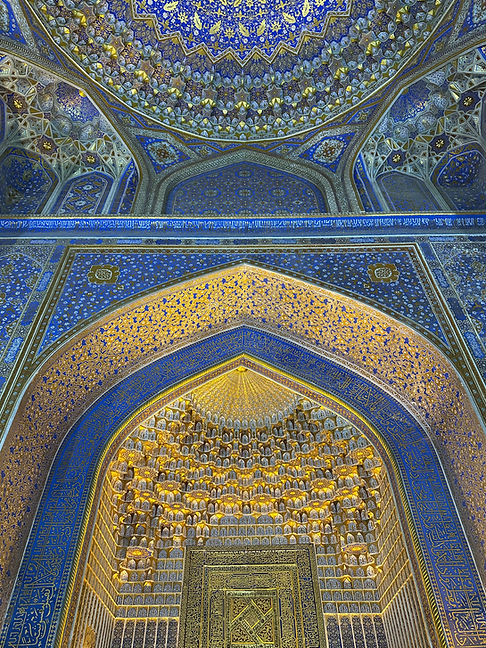

1) Registan Ensemble
Tickets: 100000 soms
Daily 9 PM: 3D Laser show, catch it from the Observation Square for free
The Registan Square is the pride of Uzebikstan and as one enters the arena, the towering magnificence is awe-inspiring. The beauty, motifs, history and architecture is one for the years. Constructed between the 15th and 17th century, they epitomize the heart of Uzbekistan.


Ulugbek Madrassa: The original structure was built as a school of science and literature, where Ulugbek spent time creating future thinkers, scientists and astronomers. With his own scientific expertise, he spent time teaching because he believed that the ancestors deserved to know. The motifs on the building signify stars and the cosmos, given Ulugbek’s love for astronomy.


As you saunter inside the madrassa, you find the classrooms where students received small group or individualized instruction. The courtyard itself is laden with tile work, marble bases, and a sun dial, no surprise there, considering the scientific play with the skies and galaxies beyond.


Inspired by the Ulugbek Madrassa, the other two madrassas, Tilla Kori and Sher Dor Madrassas were built much later, in place of structures that were ruined over time.


Sher Dor welcomes you with two tigers who were meant to be lions.
An ensemble where the city of Samarqand gathers every night at 9 pm during the 3D laser show, which is worth a watch.


2) Ulugbek’s Observatory:
Tickets: 75000 soms
Uzbekistan’s most profound scientist and astronomer, Ulugbek, spent his time examining the cosmos and wrote the renowned Zig-i-Kuragoni, aka the catalogue of stars which includes an in-depth insight of 1018 stars and was re-published by several translators across the world.


In an era before the telescope was invented, his team and he built a giant median arc, a quadrant used for astronomical measurements, which still exists. The observatory, unfortunately, was destroyed by opponents, after Ulugbek was assassinated by his own son.


A Russian archeologist, Vyatkin discovered the location of the observatory through the Vaqt documents that had been maintained and excavated the site in 1908.


3) Afrosiyab:
Tickets: 60000 soms
The pre-Arab & Timor era was discovered as part of Afrosiab, which entails 543 acres, and recent excavations in 1965 revealed a palace in which King Varhuman, of Zoroastrian belief, resided. As part of the excavations, a beautiful mural that spanned all four walls of the palace was found that captures the details of civilization as early as 700 BC.
The murals indicate the close relationship that was shared with the Tang Dynasty, depicted with a queen surrounded by her people on a boat. Additionally, a merchant arrived with silk cloth as part of the trade that was already underway.
Scenes include a queen, a Malika, coming from India on elephants, ambassadors welcoming folks from China, Korea and Turkey, and hunting scenes. There still remains much to be excavated and much to be learnt about the Songdian Era.

4) Shah-i-Zinda Necropolis:
Tickets: 60000 soms
Means the Living King that was built around Prophet Muhammad’s cousin, Qusam Ibn Abbas, who was buried here. It is believed that he lives on eternally, thus inspiring the name. As you walk through the necropolis, you are surrounded by 20 mausoleums, where Timur’s mother, wives, nieces as well as his commanders are also buried.


The beauty of the Necropolis remains unparalleled and the detailing of the tile work is something truly to admire.


5) Bibi-Khanym Mosque:
Tickets: 50000 soms
A mosque that almost reaches the sky, encompasses many legends. One such legend goes that Bibi Khanum, one of Timur’s wives from China, decided to construct this mosque to celebrate his victories in India. He had captured men and returned with unfathomable amounts of treasures, all of which he brought back on Elephants. All of these were utilized to build the grandest mosque, and this was overseen by Bibi Khanum while Timur was away on his next conquest. The hired architect fell madly in love with Bibi Khanum and kept delaying the project. His condition to complete rested on him kissing Bibi-Khanym, lol. Frustrated at the delay and wanting to have the mosque ready for Timur’s return, Bibi-Khanym agreed to the architect’s conditions. When Timur found out, he was furious and he executed the architect. Apparently, it is this very incident that resulted in women having to cover their heads to prevent temptation!

Timur too, wanted to make the mosque even bigger and insisted on increasing the size, however, the building started crumbling while it was being constructed. The mosque was in ruins soon after it was built and much of the restoration was undertaken during and post-Soviet era, which was overseen by the first president of Uzbekistan who wanted to pay homage to the Timurid dynasty.
Samarqand to Tashkent: Book the Afrosiyob, a high-speed train, which brings you back to Tashkent in exactly 2:21hr.
Cost: 275,000 Som


Tracing the history and reveling in the food
2500 years old, Uzbekistan has had a range of historical influences
.
In 1 millennium BC: Songdian Era with influences from Hellenistic culture were evident in Transoxania and since King Phillip II from Macedonia who was heading to the East, was assassinated, his son Alexander hailed towards present day Uzbekistan

We absorbed the experience in its entirety, sharing a picture from the internet
Source: https://en.unesco.org/silkroad/content/cultural-selection-afrasiab-paintings
Known later as Chachkent or Shi, this was part of the Chach State, the Persians and Chinese used it as a trading point
.
In the 6th century the city came under the rule of the Turkic Khaganate and in 751 AD, the Arabs deemed victorious
.
It was between the 9th & the 13th century that the name Tashkent (Stone City) appeared in the Turkish records
.
In 1220, leading the Mongol invasion, Chengis Khan hailed to Uzbekistan. Camping in Yurts, they traveled and invaded far and wide. The Mongols did not believe in settling and nurturing their conquered lands, instead they ordered the destruction of so many treasures and only focused on invading, plundering, looting and expanding their presence.
The food in the pictures below are all national dishes of Uzbekistan 1) Manti (Steamed Dumpling), 2) Friedn Chuchvara (deep fried dumpling), and Lagman (a delicious noodle soup).


The 14th century brought with it one of the greatest empires that Uzbekistan still celebrates, the Timurid dynasty that was affiliated with the renaissance of Uzbekistan. With its focus on architectural beauty and the arts, Amir Timur led the way for a dynasty that eventually made its way to India with his successors building the inspirational Taj Mahal. Though Amir Timur had no direct ancestral roots linking him to Genghis Khan, he married into the descendant line and with his commanders, the name Gurkan, which means son-in-law was proclaimed.
The influences of Kebabs, eggplant, and anor (pomegranate) can be traced back to this time.


In 18th century, Uzbekistan came under Soviet rule, and the Soviets played a big role in renovating some of the ruins from the Timurid Dynasty. It seems they also took some liberties, for instance they added a dome on the Tilla Kori madrassa.
It appears that this did not make the Uzbekis the happiest, because it’s the only dome that is not lit at night in the Registan ensemble and neither is it a part of the 3D laser show that happens every night.
Also, we start to see european (read Russian) influences on the food - Chicken Kiev, and Lamb Shanks with Potatoes.


In 1965, an earthquake struck and destroyed much of Tashkent. Under the Soviet reign, the city was rebuilt and currently stands as an expansive city with spaced-out roads, gardens interspersed through the city, plazas and central spaces bringing people together, sidewalks with cafes and restaurants making it a fun place to visit.
In 1991, Uzbekistan gained its independence becoming a presidential constitutional republic system. The first president remained in power for around 24 years and ensured that all architectural elements of the Temurid dynasty were restored as a way of paying ode to Amir Timur. He wanted Timur to be remembered for his legacy not ruins, which has resulted in a boost to Uzbekistan tourism.


