
BARCELONA, Do we belong?
- By Kamiya Kumar
We start off as strangers,
I don't know what to expect, what to anticipate,
I don't know you, you don't know me.
I've been thinking about you for a while though
planning my summer around you.
And yet when I reach my heart is speculative,
will you be everything I'd imagine you to be
Will I be everything I want to be
We glance at each other, from the corner of our eyes
merely brushing our shoulders
almost but not quite fluterring our eyelashes .
I take my first walk, everything is new
Initially I don't stray all that far, but stay closer to my new base,
can I even call it home?
My first meal will now remain a distinctive memory
I take a pitstop in a cafe, it always helps in making the estranged slightly more known
I spend time soaking in the ambience, watching people as they go by
Some are local some are tourists
I sit still amidst the hustle and bustle, only to call it a day.
What do you have in store for me, I'm yet to discover.
One ginormous step towards you is that I'm here initially to learn your language.
I hire a bike and start exploring
as I whiz by the same cafe's, restaurants, where I had walked the last evening.
As the days go by, we start developing a relationship, more intimate
Everything that was new, starts to become familiar
I begin to learn some of the ways and reduce the use of my maps,
I know where I'm going more or less perhaps.
Yet a different turn, a different direction takes me to a whole new place,
Never before seen or experienced.
I'm currently in between the old and new, feeling comfort yet adventure.
It's not all smooth,
people have sometimes been unnecessarily rude
Deflating my bike's tyre
Leaving me bewildered and angry.
But paradoxically, this only brought me closer
Made me feel more in the groove!
The journey continues,
finding you and finding me
Oh Barcelona, you're not a stranger no more,
So then,
Who are we?
Do we Belong?
Will I long?
for you when I'm gone?
I guess, we wait and find out
till then, I'm present
I'm living, I'm turned on ;)

Barcelona
Places to explore:
-
Gaudi’s Sagrada Familia
-
Park Güell
-
Barrio Gotic
-
Museu Picasso
-
Plaça Catalunya & Las Ramblas
-
Be a beach bum
-
Plaza España, Magical Fountain
-
Bunkers Del Carmel

Sagrada Familia
Tip* It is best to buy tickets online in advance, since tickets often get sold out.

Gaudi’s masterpiece, Sagrada Familia which intends to bring people together regardless of differences in race, religion, sex etc. Commenced in 1883, Gaudi worked on the Sagrada till his death in 1926. He only lived to see one facade completed, which he wanted to build as a sample for the rest of the three sides, and the crypt, where his tomb currently lies. The church is intended to be completed in 2026 to celebrate Gaudi’s 100 year death anniversary. The interior of the church is something like I’ve never seen before, with Gaudi envisioning space to be the protagonist. You walk through a forest with the columns extending into the ceiling in the form of branches.


$1000 per person
20
days
07/29/18-08/17/18
Getting There
Flight from Rome, Italy to Barcelona, Spain
-
Duration: 1 hour 50 minutes
-
Airline: Alitalia
-
Cost: $9 + 11,256 points, one way direct
Stay
Barcelona
-
Accommodation through the Language School, Cervantes [Learn Spanish while in Spain]: $21 per night / $150 per week
-
Location: 5 minute walk from Plaza España
-
Rating: 4 out of 5 [Heads up: No air conditioning & Barcelona summers are HOT]
-
Generator Barcelona Hostel: $30 per night
-
Location: 6 minute walk from Diagonal metro station
-
Rating: 5 out of 5
Madrid
-
Hostel Mola: $34 per night
-
Location: Close to the City Center
-
Rating: 3 out of 5
-
Location: In the heart of LGBTQ friendly area
-
Rating: 3.5 out of 5
Granada
-
Pensión Suecia: $28 per night for 2 people
-
Location: Central
-
Rating: 3 out of 5
-
Comments: Place is very cute, rooms were average.
Sevilla
-
Barceló Sevilla Renacimiento: $55 per nights + redeemed points
-
Location: Only if you have a car, does this location make sense.
-
Rating: 4 out of 5
Food Much
-
South of Spain: As long as you are ordering drinks, tapas comes as an accompaniment
-
Gazpacho Soup
-
Segovia is known for its Cochinillo {Roasted suckling pig}
Local Travel
Getting around in Barcelona
-
Hire a bike. Average rate; $12-14 / per day and for extended rentals, price is reduced to $10-12 / per day.
-
Buy a T-10 Metro Card for 10 rides across town {comes to 1 euro per ride - Steal of a Deal}
South Spain
-
Hire a car to drive through the country
-
Sixt Car Rental: 40 euros per day
Tickets to be purchased in advance
Click links below to be redirected;
Barcelona
Granada
Cordoba


The colored glass is thoughtfully incorporated with the East end entailing colors of blue green signifying the morning and the West has hues of yellow orange red seemingly the sunset. Each facade of the church tells a different story, with one end representing the birth of Christ, another the glory, passion and pain of Christ and finally, the death of Christ. The top could be interpreted as the ribs and the extended arms as muscles & bone. Gaudi wanted everyone visiting to be connected with the divine so he built each facet with a goal of strengthening the connection. Gaudi imagines the front facade to be a musical organ with music playing through the city. He limited the height of the church to be slightly lower than the close-by mountain because he believed that the work of man should never exceed that of God!
Park Guëll


Tickets; Buy tickets online in advance. Alternatively, the park is free from 6:00 - 8:00 AM, great excuse the kick start the day nice and early.
Gaudi envisioned this park in 1900 and his Chef, Güell executed his plans to build it. Güell was going to move in but eventually Gaudi stayed here from 1906 - 1925. With beautiful mosaics, Gaudi was very much inspired by nature and moving away from linearity, aimed to integrate the curves & curls into his structures.
The park is free from 6-8 AM and it’s completely worth waking up to witness the sunrise as you meander through the park and Gaudi’s fairy-tale like architecture.
Barcelona and Gaudi are synonymous - As you take a turn, you come across Gaudi’s modernisme architecture in the form of homes, some being Casa Battló & La Pedrera.
Barrio Gotic


The oldest neighborhood of what used to be called Barcino before it became Barcelona. Made by the Romans 2000 years ago, the Gothic Quarters is a well-preserved fortified part of the city with tiny streets that keep you cool in the sweltering summer sun. Walking through history, you come across the Temple of Augustus, where columns are being maintained from the original temple that had been built similar to the Pantheon in Rome to earmark Augustus’s, the first emperor conquests in Spain. In Plaça Nova, stands the Bishop’s house, the presence of whom distinguishes a Cathedral from a Church. The Plaça connects to the busiest streets of Barcelona as well as the Parliament House & City Hall, from where the region of Catalonia is governed.
Museu Picasso


Picasso apparently spent elongated afternoons with his buddies at the famosa Quatre Gats.
Tickets; Tickets can be booked online in advance, though they are easily available on the same day if you don’t mind waiting in queue. Student discounts are available so if you’re studying I’d suggest carrying your student Id’s.
Picasso’s museum in Barcelona showcases the progression of his work from when he was 13 years old. His dad was a painter and an art teacher, who very much inspired Picasso’s journey. Every time Picasso drew a male figure, he said it reminded him of his dad. The museum has a permanent exhibit, which includes his series on The Pigeons and Las Meninas and a temporary exhibit, which at the time, included exhibits on Picasso’s kitchen. As you browse through the collection, you eventually come to his cubist perspective, but as I was looking at the work displayed, all I could think of was Hannah Gatsby’s Nanette (available on Netflix). She asserts the importance of cubism but not without highlighting how his multiple perspectives did not take women’s perspective into consideration!
Plaça Catalunya & Las Ramblas, and Plaça España
Prominent landmarks in the city of Barcelona, you’ll always find Plaça Catalunya & Las Ramblas buzzing with people, both local and tourists. Plaça Catalunya, with fountains and gardens, connects the old and new city. At one of the corners, you can see an odd-shaped monument dedicated to Francesc Macià, who in 1931 declared Catalonia as independent. During the recent protests, thousands gathered here to voice their dissent. Leading into Las Ramblas, the street extends downhill with mosaic on the pavement representing a stream, which is what it used to be in medieval times.
Plaza España is located in the Sants-Monjuïc district, facing the Palau Nacional, the national museum of Catalan visual art. At the Palau Nacional, you can enjoy the magical fountain (from Wednesdays - Sunday) at 9:00 PM. Next to Plaza España, is an arena, which used to be for bull fighting, but with Catalonia prohibiting bull fights, the arena is now used for shops. On top of the arena is an array of restaurants from where you get to enjoy the view of Plaza España. A great place to grab a bite and sip on some sangria out in the open terrace.

Bunkers Del Carmel and Beaches around Barcelona

Originally built as an anti-aircraft defense site in 1938 during the Spanish Civil War, the bunkers were used as a strategic point to survey and protect the city. Today, the bunkers serve as a beautiful mirador for the city of Barcelona.
In the city of Barcelona, you can find Barceloneta Beach, which is far too crowded and filled with tourists. If you continue down the coast, towards the end is Bogatell Beach, where you will be lucky enough to find a relaxing spot. However, my recommendation is to take a train (for which the metro pass will suffice) 20 minutes away to Montgat, where the water is turquoise blue and the beach is beautiful. Prepare to spend an entire day soaking in the sun, taking dips in the Balearic Sea, as you take pit stops to eat paella in authentic Spanish restaurants in the cute town of Montgat.


Granada

The city center of Granada is defining of a small town with a plaza that has myriad restaurants. The highlight in the South of Spain is that with every drink you get tapas free, so you can continue endless nights of sangria with a variety of tapas flooring your appetite.
Alhambra and Nasrid Palace; Was initially built in AD 889 on Roman fortification remains and it was in the 13th century when the first Sultan King Nasrid hailed from Persia to expand their empire in the South of Spain. He built this glorious palace, which has the most intricate carvings, with mosaic and paintings making the palace a wonder to walk through and I’m presuming, live in. Standing atop the hilltop as most castles are, it is strategically located to get an expansive view of the city. With Alcazaba towering over, the fortification was a military zone that ensured the sultanates remained victorious. As you step inside the Nasrid Palace, you’re struck by the beauty as you stroll through the court of the lions, royal quarters where all the decision-making took place, paintings that depict their lives, conical roofs that are carved out of stone ensuring the heating & cooling were naturally built in, majestic doorways and thrones and their focus on weaving water availability to the castle. There are tiles above doors that have a painted key indicating a welcome, a characteristic common in Islamic architecture.


There is a clear distinction between the architecture of the Sultans and Christians in Alhambra. The christians conquered the South of Spain in the 15th century. However, the amalgamation of Islam and Christian architecture, come to be known as the Mudejár style or Moorish architecture is truly special, which you will witness through your travels across the old cities and towns spanning the South. As one of the anecdote goes, a Sultan King imprisoned his three daughters in a tower at Alhambra, because they were thought to be stunningly beautiful. However, two daughters fell in love with two Christian Knights who climbed through and whisked all three away. The third daughter decided to return mid-way and died during her attempt to return. As these legends depict, interracial love and marriages has resulted in the mixing of diverse races and cultures, making humankind ever so more enriched.
Ronda
Next we drove down to Ronda for the day; During the industrialization period, a group of people who came to be known as the Romantic Travelers identified places that were being destroyed due to the fast-paced development and aimed to spread awareness to protect and preserve the authenticity and beauty of these places. Instead of viewing success as the majority was, basing it on status and reason, they were contesting these notions and looking for inspiration (Simply Beautiful, I thought!). And you find that in Ronda without looking too far.
One day in Ronda? Don't miss
-
Central Plaza
-
Puente Nuevo


Ronda is a damn cute place, you can begin in the central plaza devouring some delectable food. And then walk across town through the dwindling streets towards Puente Nuevo, a magnificent sight, with the bridge stretching 120 meters deep into the gorge. Built in the 19th century, it’s fairly recent but was built further on Roman discoveries. The new bridge and the old bridge connect the town since Ronda is placed high up on a hilly region. Additionally, there is a bullring, which we decided not to enter since the ticket funds are channeled towards the fights that continue to happen in the month of September. Highly recommended, I would suggest staying in Ronda for 2-3 nights to truly imbibe the historical town’s feel.


Sevilla
Driving up from Ronda, Seville in comparison is an expansive city. We spent a considerable time in the Alcazar, a gorgeous example of Mudéjar Architecture, which is the oldest royal palace in Europe still in use. It was built for a Christian King on the site of a Muslim residential fortress after the Christian conquest of Seville. It’s worthwhile to get the audio tour and if you carry your own set of headphones, two people can optimize one.
One day in Seville? Don't miss
-
Alcazar
-
Seville Cathedral
-
Giralda
-
Torre Del Oro
-
Triana Neighborhood

Walking from the Alcazar towards the Seville Cathedral lends itself to a beautiful view of the front facing façade of the Cathedral. Feel free to grab drinks or food while enjoying the picturesque site in front of you. You can climb the bell tower of the Cathedral known as Giralda, which is supremely high up and from where you get to view the entire city. Next, we headed to Torre Del Oro, a military watchtower, which used to be a prison in the middle ages. Currently, an exhibition displays the explorers & mini-replicas of ships that had been used in the 15th century. As you spiral your way up, you see the city surrounded by the Guadalquivir River. It’s free to enter on Mondays. Triana Neighborhood is a fun place to culminate the day, it has several restaurants and bars, but aim to be there by 8 as places start to shut down by 10-11. We also walked along the river to explore bars that were open till late at night.


Cordoba
I do have to say that the small towns of Spain are where it’s worth spending all one’s time. In retrospect, I would have rather reduced my stay in the big cities of Barcelona and Madrid, to extend my time in cities such as Cordoba. The main place of exploration here is the Mezquita, Mosque-Cathedral of Cordoba. It was constructed as a Mosque in 784 A.D. by Abd Al-Rahman I and was continually expanded by Muslim rulers that followed after. It was around 1236, when the Christians took over Cordoba converting the Mosque to a catholic church. During the 16th century, the central part of the church was completed to include a Renaissance Cathedral.


When you step inside the Mezquita, you experience the expansiveness of the horizontal space, apparently, made with the intention for the spirit to roam freely and connect with the divine. There are 856 columns and arches that stand today, with the arches possibly symbolizing date palm trees. Facing the direction of Mecca, is the Mihrab, which is most exquisitely decorated. Shockingly enough, since the 2000’s, the Muslims have been seeking permission from the Roman Catholic Church to pray at the Mezquita but have been continually denied by the Church in Spain & Vatican.
With supremely tiny streets, the town is delightful, with at times only two rows of people being able to walk simultaneously and tucked away inside these lanes are restaurants that have excellent food. I gunned for their tapas, which included salmon salad and croquettes, which were oh my gawd delicious. At a short distance away is the Roman Bridge, with makes for a scenic backdrop. Originally built as early as 1st century BC, it continues to stand strong with several reconstructions, very much characteristic of Cordoba.


Segovia
About an hour away from Madrid, the drive to Segovia is beautiful and the town even more so. Single lane road by the mountain, it’s a haven for cycling, if you’re a serious biker!
One day in Segovia? Don't miss:
-
Roman Aqueduct
-
Jewish Quarters
-
Try Cochinillo [Roasted Suckling Pig]
-
Alcaźar, if you missed it in Seville.
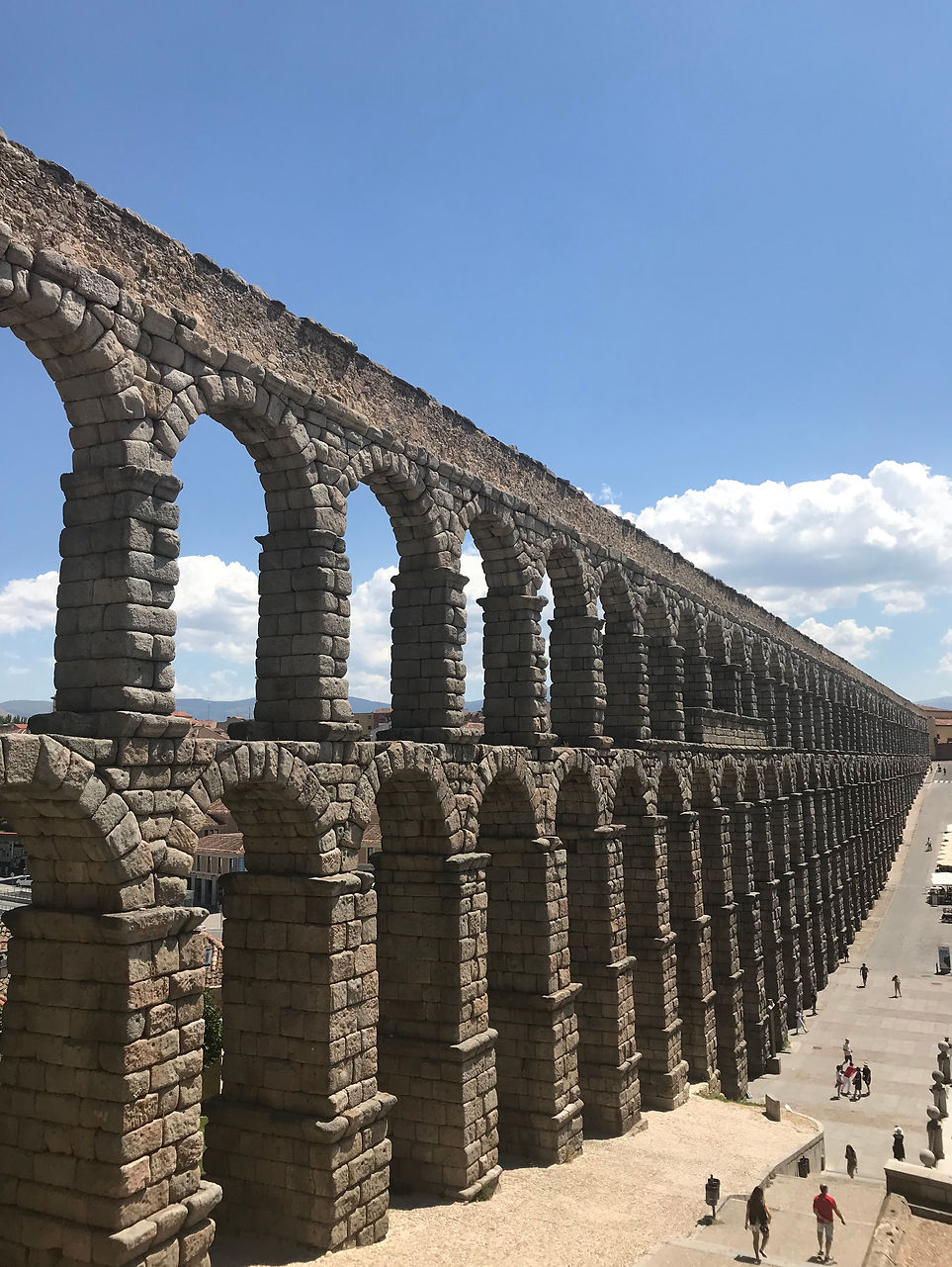


Segovia can be a day trip or you could spend a few days here to really soak in the vibe of this ancient Roman city. As you enter town, larger than life stands the 160 perfectly preserved aqueducts columns that are 2000 years old. The sheer scale of these structures makes you marvel at the engineering skills of the Romans.
Segovia is very famous for it’s slow roasted pig, which is to be honest, a little intense in taste, flavors and sight [being a baby piglet].
Toledo
A UNESCO world heritage site, Toledo is a historical city of Spain, which is an hour’s drive from Madrid. If you’re driving up from South Spain, it makes sense to break the journey in Toledo, spending a day minimum if not more to enjoy the quaint town as you wander through the small alleyways.
It’s a city where all three faiths, Christianity, Judaism & Islam come together in co-existence. A centralized ticket [around 10 euros] enables you to see most sites in Toledo.


One day in Toledo? Don't miss:
-
Santa Maria La Blanca; Oldest Synagogue in Spain, where Jews arrived immediately after the temple in Jerusalem was destroyed by the Romans in the 1st century A.D.
-
Alcazar; Dates back to 3rd century A.D. and currently is a museum for the armed forces
-
Sinagoga Del Transito; Synagogue built in the 14th century with intricate stucco artwork
-
Toledo Cathedral; Built in Gothic style, the cathedral has a baroque altar
-
Alcantara Bridge; The Bridge has been built over Tejo river that extends all the way to Lisbon
-
El Greco’s Art; Originally Greek, El Greco’s work was a precursor to Cubism & Expressionism. Two of his paintings are displayed in the Toledo Cathederal.
-
Mirador del Valle; for the best view of the city


Madrid
After exploring the small towns, the big cities in Spain are great for relaxing, eating good food and the nightlife. Madrid is all about the different neighborhoods, so the city can be discovered on foot. Some of the main sites are Plaza Mayor and Baroque Royal Palace. An interesting tidbit about statues is that if the horse has the front legs up, its indicative that the rider died in battle, one leg up means that the rider was injured in battle and if the horse is standing on all fours, the rider died of natural causes. We devoured Churros every moment we got, fried sugar dipped in chocolate, yum. One of the best places for Churros in Madrid is Chocolateria San Gines, which has been serving chocolate con churros since 1894.
Templo de Debod also known as the Egyptian Temple is of a distinctive architectural style in Spain, since the story goes that the Egyptians donated this temple in 1968 in appreciation of the assistance provided by Spain. Apparently, during the construction of the Aswan high dam in Egypt during the early 1960’s, archaeological sites faced severe ramifications and UNESCO appealed for international help. The first two arches serve as the gateway to the temple, which was constructed as early as the 2nd century BC with some of the decorations being completed by the Roman emperors Augustus & Tiberius, thus, the columns in the temple. Seeing debod in the hues of the sunset was magical.


